

What does a Full Body Assessment Mean?
What really happens when you undergo a Full Body Assessment?
The full body assessment is our way of assessing all the major joints in the body, head to toe. We use this to determine your particular injuries, underlying problems, strengths and weaknesses.
In order to do this, we wrote down and included all the important tests that may lead to these diagnoses. As knowledge and research evolves, we update these tests and diagnosis findings to reflect these improvements so that the outcomes become better and better.
Therefore, your Clinical Pilates and Strength Training program is as tailored and individualized as we can make them. We don’t try to fit you into a standard Pilates program, rather fit a Clinical Pilates and Strength Training program around you and your needs. A subtle change in an exercise or treatment can be great for one person, but the wrong approach for another.
Although there is a lot of work and assessment at the start, it means we can get off on the right foot from the start. If things do not go according to plan, we have something to compare to when revising your program.

What testing do you do in the Full Body Assessment?
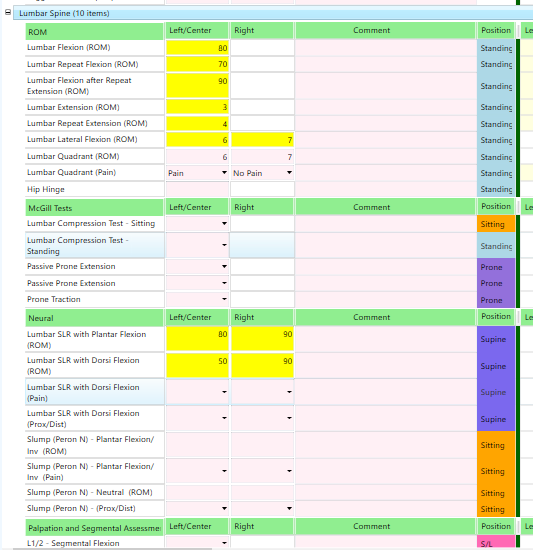
There are a large number of tests that we do in a standard assessment. The tests for the lower back (lumbar spine) give a great example of how this process works.
In the lower back we would assess the major movements, however, it’s not always the major test results that are important, but the pattern they produce. The yellow indicated tests that the standard tests we would perform in a Full Body Assessment. However, we often choose to do further testing to get a deeper picture of the issues so that your program is even more accurate. It gives further, additional information to even better customize this program and for better outcomes.
Inside a session


Every program starts with a free one-on-one full body assessment.
Book a Free Full Body AssessmentWhat happens after the Full Body Assessment?
The testing is only part of the process. It is the clinician’s job to assess all the potential diagnoses, decide what it appropriate for you and order them in order of priority. This then allows the clinician to add in treatments, stretches and other exercises that are specifically tailored to your needs.
The outcome is a very clear and well defined Clinical Pilates and Strength Training program that is easy for the clinicians to follow and help you achieve your desired results.
It also means that no matter which clinician you see, they will know exactly what to do and why. They will all have their individual styles, but the direction of your program will be same. The benefit is that you get a variety of exercises and variations to your program, but you are not limited to seeing only one clinician when choosing your appointment times and sessions.
The Re-Assessment
The next most important stage is the re-assessment, where we revise and update your program. At particular intervals:
- 7 week intervals in the first 6 months
- 3 months intervals between 6 and 12 months
- 6 month intervals after 12 months of longer
The Re-assessment is a more limited assessment compared to the full body assessment, testing those aspects that we expect to change with exercise and treatment. Standard tests in the re-assessment are highlighted in orange, but, if we will conduct other tests to get a fuller picture of your issues and to better customize the program for you if needed.
Again, your treatment plan is revised and updated so that we are always working on your latest issues, goals and targets.
Timing of the re-assessments is not random, but specifically chosen to match when we expect to see change and your body’s natural muscle growth and healing times.
The Revision - What happens if things really go wrong?
Things do not always go to plan and injuries happen between assessments. This is why we keep a very close eye on your program.
Especially in the first few weeks, when we do not know you and your body as well. Therefore, we will quickly change your program if needed. In addition, if an injury does occur, we will assess the area once again, finding whichever diagnosis is appropriate and revise your program as needed.
If we are really not getting anywhere with your program and the outcome is not what we want it to be, we will discuss your case with the whole team in our feedback meetings (usually on Thursdays). We will look at your assessment findings and program one more time, to see if we have missed anything. Because we share the files between our clinicians, we will all have a good idea about all of our clients and can have a good, robust discussion about your needs and issues.
If it is determined that we need to do further testing or need to be referred onto an appropriate medical or other health professional, we will help organise this. Our aim is to always be moving you to the next stage of your program and closer to your goals.
MD Health's 13 week program
Getting started with MD Health is easy.
Just follow these steps and be on your way to feel the benefits!
Our Physiotherapists and Accredited Exercise Physiologists will talk to you about your short-term and long-term goals and write you a specialised treatment plan.
Following your assessment our Physiotherapist or Accredited Exercise Physiologist will write you up a detailed and personalised treatment plan.
After your asessment we recommend coming in to complete Clinical Pilates & Strength Training twice a week to get the most of our your program and see the best results.
Once you've completed your 13 Week Program at MD Health we;'ll conduct a 30 minute re-assessment to check in and see how you're progressing towards achieving your goals. You'll then automatically join our MD Health Club and receive the benefits of discounted Gold Membership Pricing and free sessions!
More from the studio


Developed at MD Health by Michael Dermansky
Common questions
What does a Full Body Assessment Mean?
The full body assessment is our way of assessing all the major joints in the body, head to toe. We use this to determine your particular injuries, underlying problems, strengths and weaknesses. In order to do this, we wrote down and included all the important tests that may lead to these diagnoses. As knowledge and research evolves, we update these tests and diagnosis findings to reflect these improvements so that the outcomes become better and better. Therefore, your Clinical Pilates and Strength Training program is as tailored and individualized as we can make them. We don’t try to fit you into a standard Pilates program, rather fit a Clinical Pilates and Strength Training program around you and your needs. A subtle change in an exercise or treatment can be great for one person, but the wrong approach for another. Although there is a lot of work and assessment at the start, it means we can get off on th e right foot from the start. If things do not go according to plan, we have something to compare to when revising your program.
What testing do you do in the Full Body Assessment?
There are a large number of tests that we do in a standard assessment. The tests for the lower back (lumbar spine) give a great example of how this process works. In the lower back we would assess the major movements, however, it’s not always the major test results that are important, but the pattern they produce. The yellow indicated tests that the standard tests we would perform in a Full Body Assessment. However, we often choose to do further testing to get a deeper picture of the issues so that your program is even more accurate. It gives further, additional information to even better customize this program and for better outcomes.
What happens after the Full Body Assessment?
The testing is only part of the process. It is the clinician’s job to assess all the potential diagnoses, decide what it appropriate for you and order them in order of priority. This then allows the clinician to add in treatments, stretches and other exercises that are specifically tailored to your needs. The outcome is a very clear and well defined Clinical Pilates and Strength Training program that is easy for the clinicians to follow and help you achieve your desired results. It also means that no matter which clinician you see, they will know exactly what to do and why. They will all have their individual styles, but the direction of your program will be same. The benefit is that you get a variety of exercises and variations to your program, but you are not limited to seeing only one clinician when choosing your appointment times and sessions.
The Revision – What happens if things really go wrong?
Things do not always go to plan and injuries happen between assessments. This is why we keep a very close eye on your program. Especially in the first few weeks, when we do not know you and your body as well. Therefore, we will quickly change your program if needed. In addition, if an injury does occur, we will assess the area once again, finding whichever diagnosis is appropriate and revise your program as needed. If we are really not getting anywhere with your program and the outcome is not what we want it to be, we will discuss your case with the whole team in our feedback meetings (usually on Thursdays). We will look at your assessment findings and program one more time, to see if we have missed anything. Because we share the files between our clinicians, we will all have a good idea about all of our clients and can have a good, robust discussion about your needs and issues. If it is determined that we need to do further testing or need to be referred onto an appropriate medical or other health professional, we will help organise this. Our aim is to always be moving you to the next stage of your program and closer to your goals.
Every program starts with a one-on-one full body assessment.
Book a Free Full Body Assessment☎ (03) 9857 0644Start with a free full body assessment
Every program starts with a one-on-one full body assessment.
Book a Free Full Body Assessment*Conditions apply, see the note below the form.
Prefer to ask a question first?
Tell us what is going on and one of our physiotherapists will call you back to talk through whether we can help.
*Please note only the Full Body Assessment is a FREE service. The Full Body Assessment is for new clients at MD Health or returning clients who haven’t been in for 6 months or longer who intend to participate in our 13 Week Clinical Pilates Program**. For all new clients who wish to come in for a one-off, casual or adhoc basis for Physiotherapy or Exercise Physiology the Initial Physiotherapy or Initial Exercise Physiology appointment is a paid service. ** The 13 Week Clinical Pilates Program at MD Health is not a lock in contract and you are not required to attend for the full 13 weeks if you do not wish.