
Elbow and wrist pain usually comes from everyday use rather than a single injury: gripping, lifting, typing, gardening or sport gradually asking more of the forearm than it can handle. Most of it responds well to the right strengthening program, and finding the real cause is where treatment starts.
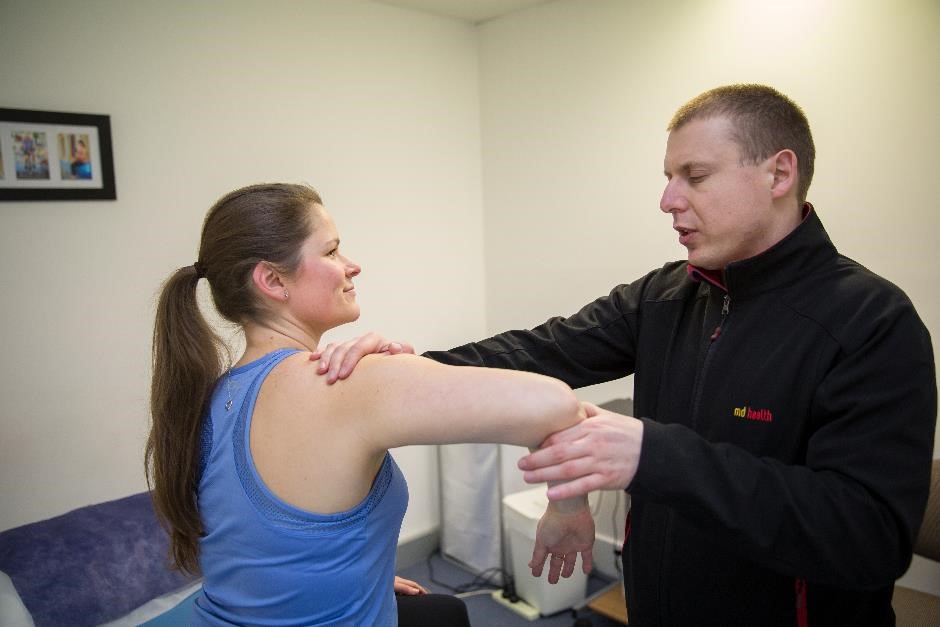
Understanding elbow and wrist pain
The most common problem we see at the elbow is tennis elbow, known clinically as lateral epicondylitis: pain on the outer side of the elbow where the forearm tendons attach. Despite the name, most people who get it have never picked up a racquet. It develops from repeated wrist and gripping movements, such as typing, knitting, lifting, using power tools, or suddenly taking on a big DIY or garden project. The tendon is loaded faster than it can recover, and small tears and irritation build up until even simple gripping hurts. Golfer's elbow is the same process on the inner side of the elbow.
At the wrist, the common culprits are carpal tunnel syndrome, where the median nerve is squeezed as it passes through a narrow tunnel at the wrist and causes pins and needles in the thumb and first fingers; tendon irritations such as De Quervain's tenosynovitis on the thumb side; arthritis at the base of the thumb; and sprains or fractures after a fall onto an outstretched hand.
One thing these conditions share: the elbow and wrist rarely act alone. Weakness or stiffness in the wrist, forearm or shoulder changes how load travels down the arm, and that altered load is often what set the problem off. It is why treating only the sore spot so often disappoints.
When to have it looked at
See a clinician promptly if the pain follows a fall or accident (a wrist fracture needs to be ruled out), if your hand is becoming weak or numb, if you are dropping things, or if pins and needles in the thumb and fingers are waking you at night. Night-time tingling that makes you want to shake your hand out is a classic sign of carpal tunnel syndrome, and it is worth assessing early because long-standing nerve compression is harder to treat.
Otherwise, if elbow or wrist pain has hung around for more than a couple of weeks, keeps returning when you go back to the aggravating activity, or is stopping you from gripping, lifting or working comfortably, an assessment is the sensible next step. Tendon problems tend to grumble on rather than resolve by themselves once they are established.


How we assess it
Every program at MD Health starts with a one-on-one full body assessment, at no cost to you. For elbow and wrist pain that matters more than it might seem, because the driver is often somewhere other than the painful spot: wrist mechanics that overload the elbow tendons, or shoulder weakness that changes how the whole arm works.
Our team is trained to assess the specific conditions of the elbow, wrist and hand, from tennis and golfer's elbow through carpal tunnel syndrome, De Quervain's, thumb arthritis and ligament injuries, using recognised clinical tests. We also look at your grip strength, your shoulder control and how you actually use the arm at work and in sport, so treatment targets the cause rather than just the symptom.
Not sure where your pain fits?
The free Full Body Assessment is a full hour, one-on-one. We look at how your whole body moves and write you a plan, before you spend a dollar.
What treatment looks like
For most elbow and wrist problems, the evidence points to graded strengthening as the treatment that changes the outcome. Rest settles the irritation, but it is rebuilding the capacity of the tendon and the muscles around it that stops the pain coming back. Your program combines hands-on physiotherapy with clinical pilates and strength training, one-on-one, built around your assessment findings.
For tendon problems like tennis elbow, that typically means stretching tight forearm muscles and progressively strengthening the wrist, forearm and rotator cuff, including eccentric exercises (strengthening the muscle as it lengthens), which the research supports particularly for tendinopathy. A counterforce brace can ease strain in the short term, but it does not fix the underlying cause, so we use it as a support alongside the program rather than instead of one.
We are also honest about limits. Established carpal tunnel syndrome that has not responded to conservative care after several months may need a surgical opinion, and persistent tendon problems sometimes warrant a sports physician's input on other options. Where that is the right path, we connect you with the right people and support your rehabilitation afterwards.
- Free one-on-one full body assessment first, so we know what is driving the pain
- Hands-on physiotherapy to settle pain and restore movement
- Clinical pilates and strength training tailored to your arm, shoulder and grip
- Clear guidance on braces, activity modification and when a medical opinion is needed
What you can do yourself
Early on, the most useful step is modifying the activity that flared it up rather than stopping everything: lighter grips, smaller doses of the aggravating task, and breaks before the pain builds. Complete rest rarely fixes a tendon problem, but easing the load gives irritated tissue a chance to settle while you rebuild strength.
Look at how your arm is loaded through the day. If you work at a computer, the position of your keyboard, mouse and forearm support makes a real difference to how much strain accumulates at the wrist and elbow. If you are starting a new sport, project or training block, build up gradually rather than all at once, because sudden jumps in load are how most of these problems begin.
Keep the rest of the arm strong. Grip, forearm and shoulder strength all share the work of everything you lift and carry, and general strength training remains one of the better protections against overuse injuries recurring, at any age.
Full Body AssessmentClinical PilatesPhysiotherapyStrength and FitnessCommon questions
I don't play tennis. Can I still have tennis elbow?
Yes. Tennis elbow is simply an overload of the tendons on the outer elbow, and most people who get it have never played tennis. Typing, knitting, lifting, using power tools or a sudden burst of DIY or gardening are all common triggers.
What are the signs of carpal tunnel syndrome?
Burning, tingling or numbness in the palm, thumb, index and middle fingers, often starting gradually and frequently worse at night, sometimes with a weakening grip that makes it hard to hold small objects. Waking up needing to shake your hand out is a common early sign. An assessment using simple clinical tests can usually identify it, with a nerve conduction study to confirm if needed.
Can carpal tunnel be treated without surgery?
Sometimes. Conservative care involves settling the swelling with rest, sometimes a cortisone injection, and strengthening the neck, shoulder, elbow and wrist to reduce pressure on the nerve. If significant symptoms persist beyond about six months, a surgical release is generally the recommended option, and we will tell you honestly if that is the direction the evidence points for you.
Should I wear a brace or strap for tennis elbow?
A counterforce brace can reduce strain on the irritated tendon and give short-term relief, so it can be a useful support, especially for tasks you cannot avoid. It does not heal the tendon or fix the cause, so we use it alongside a strengthening program, not instead of one.
How long does elbow or wrist pain take to improve?
It varies with the condition, how long it has been present and what your arm needs to do. Tendon problems generally improve over weeks to months with a graded strengthening program rather than days, and most people are able to return to the activities they enjoy. Your assessment gives us the information to set an honest timeframe for your situation.
What happens at the free full body assessment?
You spend the session one-on-one with a physiotherapist or exercise physiologist who examines your elbow, wrist and hand with recognised clinical tests, checks your grip, forearm and shoulder strength, and looks at how you use the arm day to day. You leave knowing what is driving the pain and what a program to address it would involve, with no obligation to continue.
Latest on elbow and wrist pain from our team
Common reasons for your tennis elbow pain23 Oct 2025A guide to common sports injuries (and how the pros fix them)22 Apr 2025Can you pass the ‘old man test’?12 Feb 2025 5 exercises to stay strong in 2025 despite your busy schedule20 Jan 2025Assessment of the wrist and hand8 Nov 2023
 Top 10 tips for home computer work29 Apr 2020
 What is the best Exercise for Osteoporosis?19 Mar 2020What is carpal tunnel syndrome and can strength training help?5 May 2016All articles on elbow and wrist pain →
Start with a free full body assessment
Every elbow and wrist pain program begins with a one-on-one assessment, so treatment targets the cause, not just the symptom.
Book a Free Full Body Assessment*Conditions apply, see the note below the form.
Prefer to ask a question first?
Tell us what is going on and one of our physiotherapists will call you back to talk through whether we can help.
*Please note only the Full Body Assessment is a FREE service. The Full Body Assessment is for new clients at MD Health or returning clients who haven’t been in for 6 months or longer who intend to participate in our 13 Week Clinical Pilates Program**. For all new clients who wish to come in for a one-off, casual or adhoc basis for Physiotherapy or Exercise Physiology the Initial Physiotherapy or Initial Exercise Physiology appointment is a paid service. ** The 13 Week Clinical Pilates Program at MD Health is not a lock in contract and you are not required to attend for the full 13 weeks if you do not wish.